


How and why we should support reading fluency development
In this, our most recent Teacher Talks blog, Charlotte Brabants looks at the intrinsic link between reading fluency and understanding, as part of the Daisy Education Reading Project.
The Daisy Education Reading Project focuses on strengthening reading practice, building pupils’ confidence as readers and making reading a meaningful part of life beyond the classroom
Throughout the year, we will work alongside schools to provide FREE engaging activities, challenges and resources for staff and students – including our Teacher Talks series.
Read on to find out what Charlotte had to say...
Realisation
It's funny to think about it now, especially for somebody who took pride in their understanding of reading and all its many elements, but it was remarkably easy to overlook the importance of fluency in determining a student's reading proficiency. It wasn't until at least six months in, following a pilot and then another two months of implementing Reading Plus, that the real connection between fluency and proficiency crystallised for me. Teachers all know what verbal fluency sounds like, and we often think we know what it means for student understanding, but silent fluency is another matter entirely. Until recently there was no way to measure or understand this except comprehension activities. Now there are a variety of ways to screen for and support fluency. For us, the best is through the Reading Plus programme. But what is the difference between truly making meaning from a text and hunting for answers? That’s where fluency resides, and better understanding of this has helped us to target students’ reading practice for improved comprehension. Fluent reading happens when phonemic understanding, skilled decoding and word recognition, vocabulary and background knowledge come together efficiently to enable comprehension.
Tim Rasinski, writing an EEF blog, makes clear the link between fluency and comprehension:
“Scientific research has consistently recognised the critical nature of fluency as a bridge between effortful decoding and comprehension… If readers can decode words accurately but have to employ an excessive proportion of their cognitive resources to do so, they have fewer of those resources available for comprehension. However, when readers are accurate and automatic, they can decode with minimal use of their cognitive resources, thus allowing them to channel their effort towards comprehending and making sense of what they have read.”
The penny dropped for me during a Year 8 parents evening in our first year of using Reading Plus across the school while I was explaining the Autumn term screening results. I routinely meet with parents to discuss students who are underperforming and/or not completing their Reading Plus assignments. Many parents were concerned that their child's proficiency scores within the programme were equivalent to very low primary school levels, and as I repeatedly drew parents’ attention to the fact that in all those cases where students had scored just 1.5 year-level proficiency, the student had not registered a reading rate, the inescapable link between fluency and comprehension revealed itself. I could see without doubt that reading fluency equals efficient reading, constructing meaning with control and minimal effort on decoding. This enhanced understanding has helped us tailor our implementation of Reading Plus, modify how we structure our lessons in the library, refine our discussions with students (as well as teachers and parents!), and sensibly modify our support for struggling readers and our “stretch” for proficient readers.
Awareness
Following that epiphany, with my awareness now heightened, watching what unfolded in terms of progress (or lack of progress) was easier to interpret. Were poor fluency scores the result of lack of engagement, motivation, self-regulation or skill? Timothy Shanahan tells us that:
“Low comprehension scores can mean many things. Perhaps, they signal problems with language (e.g., lousy vocabulary, syntax, cohesion, discourse structure), limited prior knowledge, or just a lack of ability to focus on the right kinds of information. If kids do have those problems, then fluency work is not likely to help. But quite often, the reason for low comprehension is that the students can’t read the text well. In other words, if you want higher comprehension, fluency work can be a powerful road to get there.”
I undertook additional research into fluency to find the best way to support students with this critical element of “the reading rope”. Previous fluency interventions with Year 10 and Year 11 students to try to build stamina and understanding in advance of exams had had limited effect. I had previously used other oral fluency strategies, including echo reading, reading along, whispered reading and repeated reading, and I had quite often deliberately shied away from poetry and lyrics. But sifting through the wisdom from a range of luminaries from the field of reading, reading research and particularly the importance of fluency means that we have started to change how we talk to students, how we analyse data, how we provide intervention and how we structure reading activities.
Now that we have multiple years of data, we can go back to see how students have performed previously and use that to help us refine our support. Explicit and consistent instructions about assignment completion and the importance of the 80% accuracy threshold is pivotal to getting students to focus on true reading. Where it is clear that students struggle with impulse control, self-management and self-regulation, we break lessons up and tailor our message about tasks to encourage students to work in time increments of no more than 20 minutes daily. In cases where vocabulary levels are near, at, or above expectations, we know that we need to really interrogate the data. We work to educate parents as well teachers and support staff about how the system works and how students need to approach their work. And we need to think about how we provide and support reading opportunities across the curriculum. Using this data allows us to quickly identify those working below expectations and forms the basis of our support for PP and SEND students, which is critical to narrowing the disadvantage gap.
Action
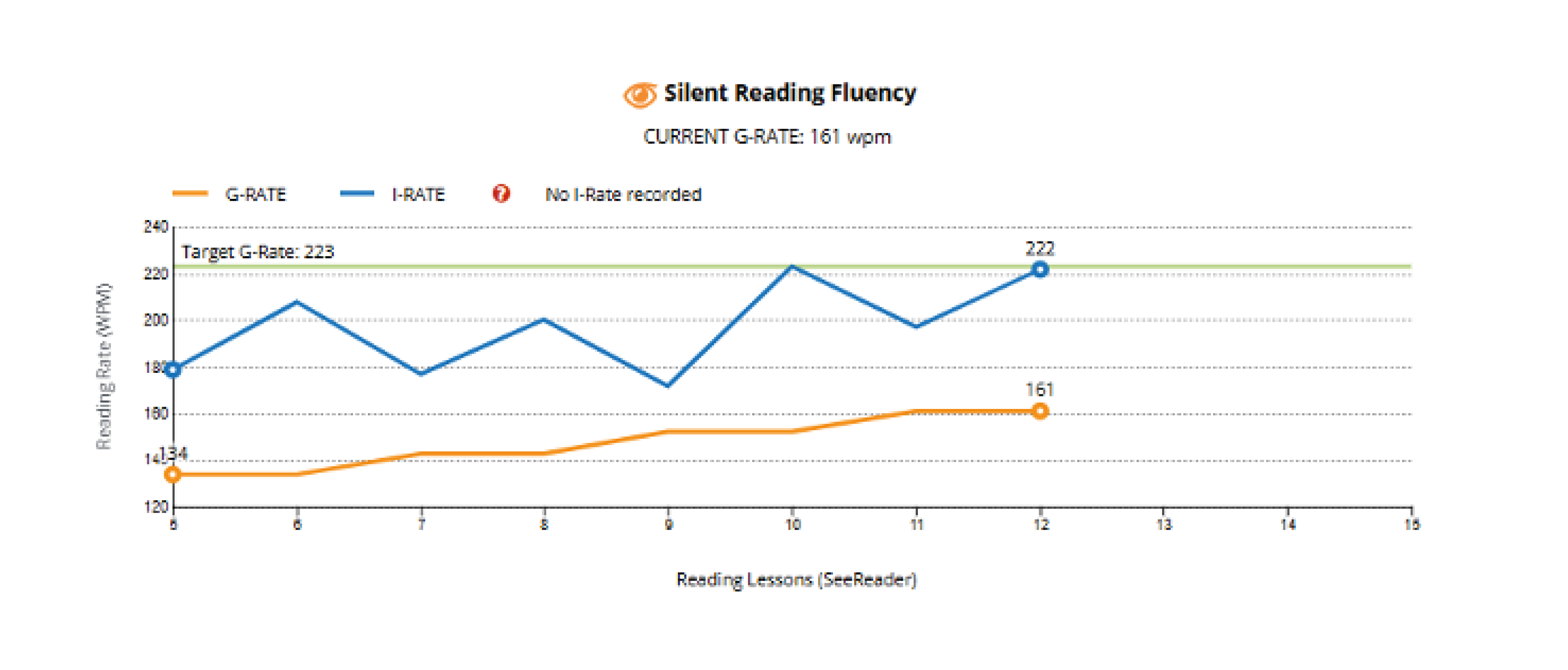
Using what we have learned, we are tweaking our practice and adding extra strategies to our reading focus during lessons in the library and interventions. The conversations with students now always include a review of their reading rate and how students can use this as a target for improvement. We make it clear that reading faster is not reading better, but we talk about why very slow reading can also impact on understanding! We use the Reading Plus fluency gain graphs to point out fluctuations in speed and encourage a smoother trajectory to the target G-Rate. We look at completion accuracy and do more adjustment of speed to ensure that students feel comfortable reading - we want to encourage ambition but keep cognitive load at the right level.
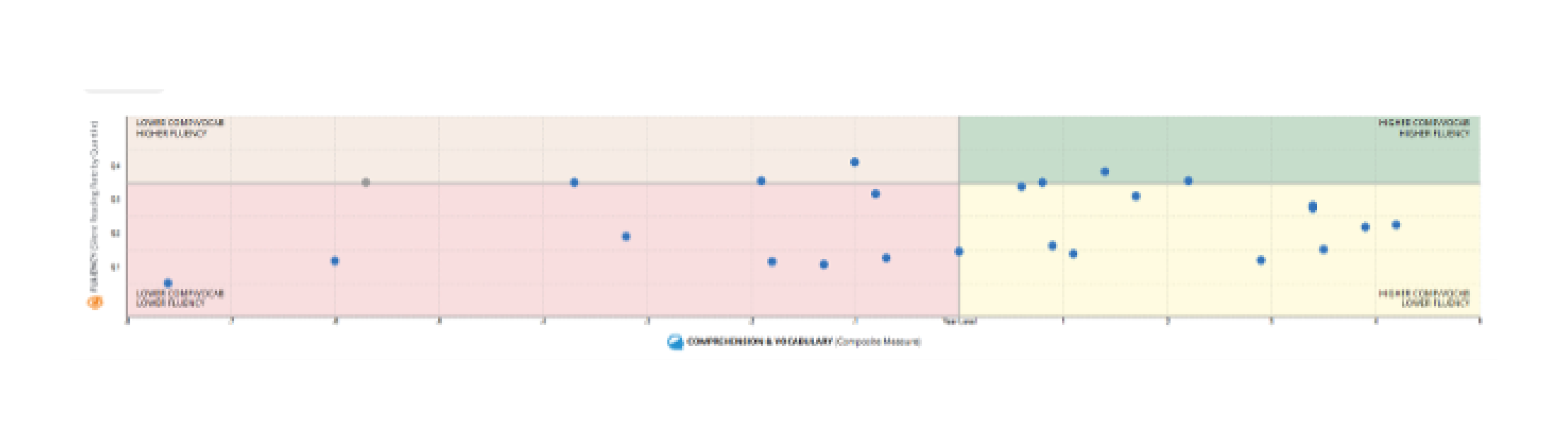
We limit how long students are on the programme during a lesson. Following Alex Quigley’s advice that “teachers modelling oral reading is an important part of fluency practice, so that pupils have the opportunity to ‘hear’ what fluent reading sounds like”, we are making greater use of whole class readers, with a great deal more teacher-led modelled reading. There is more opportunity across the school through the pastoral teams to do structured non-fiction reading to build vocabulary and background knowledge. We are re-assigning assessments more often to ensure results are reliable, and we will also be doing a small experiment to use AI fluency testing as well as NGRT to validate our Reading Plus screening results. Our interventions this year will increasingly be used to support fluency development in small groups or on a 1:1 basis. We are deliberately using the Reading Plus screen report to identify students for intervention, as well as to shape student and parent appreciation for the complexity of reading and the interconnectedness of the various elements. The explicitly-stated goal is to move students with higher comprehension and lower fluency to the green quadrant of high comprehension and high fluency. We talk about the fact that being an efficient reader means that you read in larger chunks more accurately and with increased speed.
At the same time, we insist on the 80% accuracy target, focusing on incremental gains. Of course, we encourage students to use their Re-Reads (a scaffold that revisits sections of the text to help answer the comprehension questions) for improved accuracy, but we encourage students to read actively in a focused manner. For students at the slower end of the fluency spectrum, we are making greater use of Visual Skills tasks to develop eye control and encouraging students when reading texts off screen to use rulers, fingers or other guides.
Driven by greater understanding and rich data, we continue to help our students make gains in their reading levels. By enriching our offering and using the data to guide lessons and interventions, we hope that these gains persist and that our students develop those strong proficiencies and great reading habits that will last a lifetime.
Charlotte Brabants
Whole School Literacy Coordinator, Transition Coordinator, Staff Governor, Lead Practitioner.